Eustrephus latifolius

I’ve been wanting to stop at Boondall Wetlands for the longest time, and today I finally did. The reserve supports various plant communities including eucalyptus and melaleuca woodlands, remnant rainforests, ironbark forests, casuarina forests, grasslands, tidal mudflats, mangroves, swamplands, hypersaline flats and salt marshes.

It’s a great birdwatching site—apparently over 190 species of birds use the various habitats throughout the year—but I visited in the middle of a hot day so didn’t see much bird action. Definitely worth a return visit at other times and seasons.

green and pink

Around here, you can’t swing a quoll (not that you would) without hitting a park or green space. Mature trees, creeks, and playgrounds abound, which provide huge quality-of-life enhancements to residents, whether they realise it or not.

Brisbane has, on average, 54 per cent green cover, though, as in most cities, affluent areas have more mature trees than poorer suburbs. (In comparison, Melbourne had just 23 per cent total tree cover in 2020, and Sydney had 34 per cent. All three cities lost green cover between 2013 and 2020.)

Needless to say, I’ve been spending time every day in the nearby green spaces, mostly just sitting and breathing it all in. Today, there was also a little sketching in a pink cafe with a fancy chandelier. It’s good to mix it up.

Trichonephila edulis

There are sooooo many golden orb weavers (Trichonephila edulis) here in the Australian sub-tropics at this time of year; every garden sports half a dozen or more, it seems. Their tangled webs are large, strong and sticky, so one needs to be careful when walking outside in the dark. The spider’s bite is not venomous, though it can cause pain and swelling. Perhaps you’d like to try biting back: edulis means edible. The spider has apparently been considered a delicacy in Papua New Guinea and New Caledonia, plucked by the legs from its web and lightly roasted over an open fire.

The koala (Phascolarctos cinereus) on the other hand, is much harder to spot. So I was pretty happy when all my neck-craning paid off this afternoon, down by the creek.

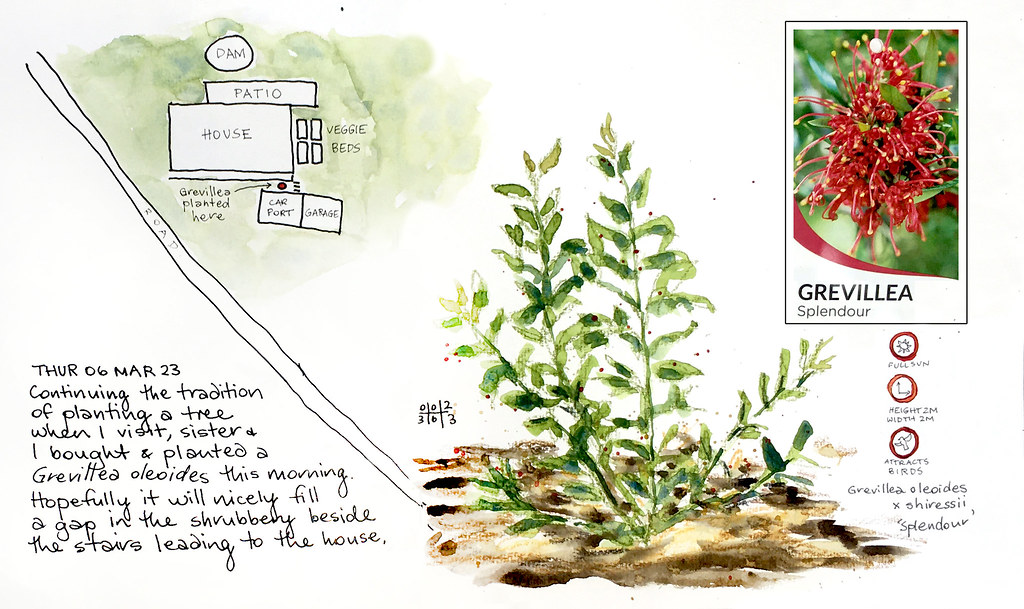
Grevillea oleoides

My sister lives on a bush block, and there is absolutely no shortage of trees here (mostly eucalypts and acacias). But I still like to add to the assortment when I visit. It started when Mum died and we planted creeping boobialla, Myoporum parvifolium, in her honour (she had breast cancer — get it?) When Dad passed he got a Grevillea ‘Ned Kelly’, to celebrate his love of Australia folk legends. We don’t need the excuse of someone dying to plant a tree; now we do it each time I come.

Mulligans Flat

Last night we went on a guided night hike at Mulligans Flat, a 1285ha (3175 acre) predator-fenced woodland sanctuary near Canberra. Several native species have been successfully reintroduced here, including the Eastern Quoll, a marsupial about the size of a house cat, and the Eastern Bettong, a little macropod, both of which we spotted. We also heard Stone Bush-curlews and saw Superb Parrots, Eastern Rosellas, Sulphur-crested Cockatoos, Eastern Grey Kangaroos, Red-necked Wallabies, Swamp Wallabies, many Common Brushtail Possums and orb weaver spiders, and one teeny frog. It was awesome!