We have a LOT of snails at the moment; they especially love the citrus. As I picked them off the trees this morning, I checked the whorl orientation, and yep, they were all dextral. It would be fun to see a sinistral snail! The idea makes the daily removal somewhat more interesting.
Digger bees, although solitary, nest in large aggregations. Each female digs her own tunnel, which can be up to a foot deep and have several branches. Each branch terminates in a chamber where the female lays a single egg, providing it with pollen and nectar collected from flowers. The larvae hatch and consume the stored food, then grow into pupae and then into adult bees, all while underground.
Next spring or early summer the adults will emerge, mate, and do it all over again … Right now we‘re at the mating stage, by the looks of things! I don’t know if they will re-use the existing tunnels or dig new ones. I‘ll keep checking on them.
There are also a few bee flies (possibly tribe Villini) hovering about at ground level. The larval stages of bee flies are predators or parasitoids of the eggs and larvae of other insects. The adult females usually deposit eggs in the vicinity of possible hosts, quite often in the burrows of beetles or wasps/solitary bees. So I’m pretty sure that’s what they’re looking to do! It’s a fly-eat-bee world.
Clarkia unguiculata is commonly known as elegant clarkia. It is endemic to California, where it’s found in many woodland habitats, including the understory of oak woodlands here in the Santa Monica Mountains. It’s one of my favourite wildflowers, and not just because my last name is Clark 😊.
The showy flowers have hairy, fused sepals forming a cup beneath the corolla, and four petals up to 2.5 centimeters long. The paddle-like petals are pink to reddish to purple and have a slender “stalk” and diamond-shaped or triangular “tongue” (sorry, are there more correct names for parts of a petal?). There are eight long stamens, the outer four of which have large red anthers. The white stigma protrudes from the flower and can be quite large.
The above paragraph does nothing to convey how pretty this plant is! It really is very elegant.
I have lived within an hour’s drive of Conejo Valley Botanic Garden for decades. How is it that I never visited until the other day? What a lovely place! What other nearby natural joys am I missing out on?
It was a delight to come upon an unfamiliar, yet local, oak tree, Quercus tomentella. This species is a relict. Though it is now limited to the offshore islands, it was once widespread in mainland California, as evidenced by the many late Tertiary fossils of the species found here. The tree in the gardens is young (planted 1995). All going well, it should grow two and a half times this high. Live long and prosper, Island Oak!
Fun morning sighting. I only ever see one thrasher at a time, usually dashing across the driveway, so I don’t know if there are multiples here. But I’m always happy to spot this mockingbird relative.
I’ve been seeing the osprey hanging about this month, but my eyes and camera aren’t up to the task of recording the finer details. Big thanks to local birder-photographer Chris Tosdevin for this great original image; I had fun sketching it.
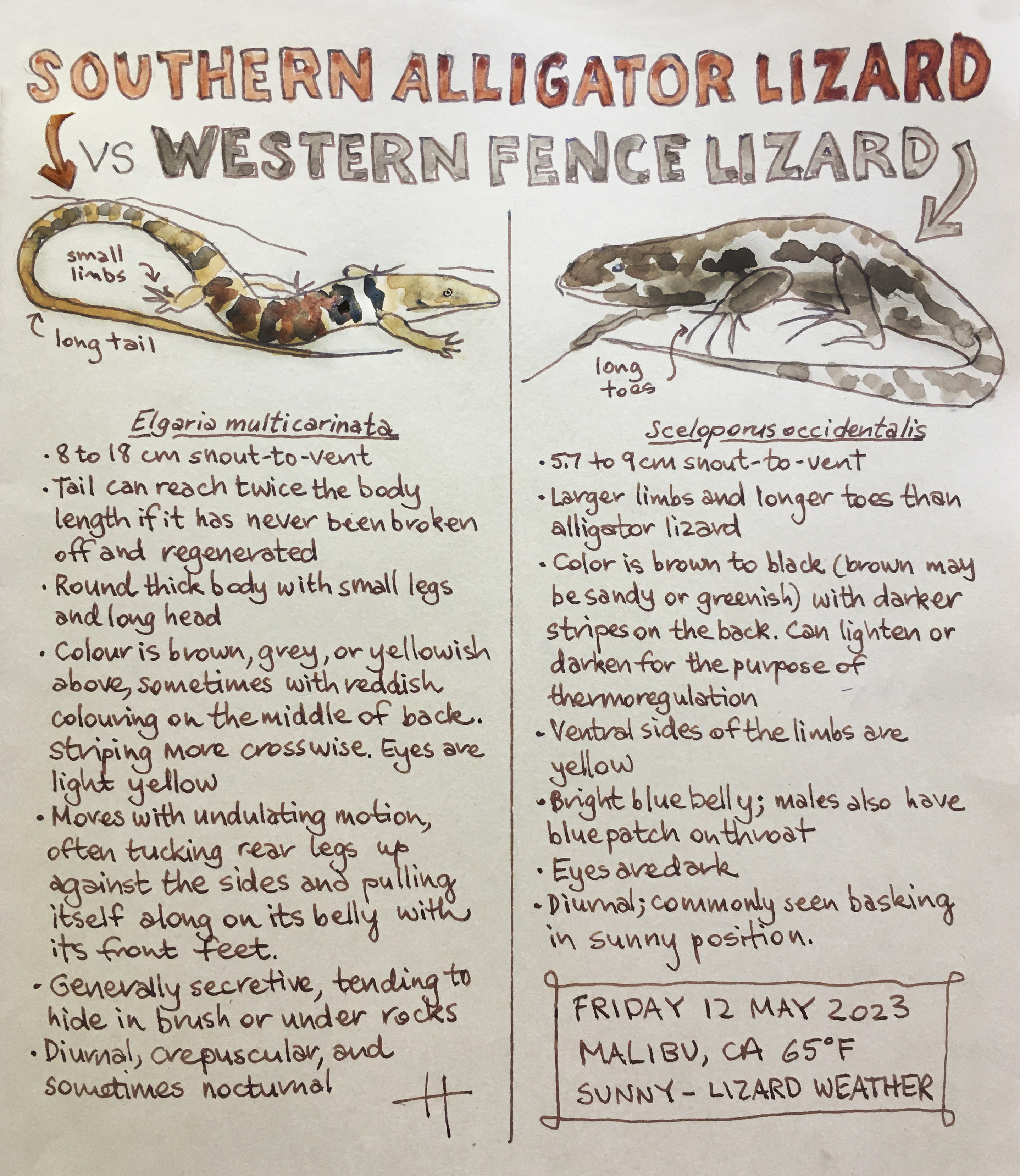
With our local lizards having such variable colouration, telling them apart is more about shape and behaviour than it is about colour or patterns. Our most commonly-seen reptile is the western fence lizard, who loves to bask in the sun, gripping with long toes or doing pushups. Alligator lizards are seen less frequently. They have long, slightly prehensile tails and a snake-like way of slithering. Now that I’ve journaled the differences, I don’t think I’ll ever get them confused.


 hashiworks