Solidago velutina

It was fun to nature journal this plant at Charmlee Wilderness Park; it was alone beside the trail, with no siblings in sight. I didn’t know what it was called till I saw Suzanne later and she identified it from my sketch.

California Goldenrod (Solidago velutina ssp. californica) has a basal rosette of leaves that are still present at flowering time. The leaves get progressively smaller higher up on the stem. Each leaf has three prominent veins running from the base to near the tip. One plant can produce as many as 500 small yellow flower heads in a large, branching array at the top of the plant. The flowers remind me of goldenbush, and in fact both plants are in the Asteraceae family.

Salvia brandegeei

Salvia brandegeei, known commonly as Santa Rosa Island sage or Brandegee’s* sage, is a perennial evergreen shrub within the mint family. Initially presumed to be exclusive to Santa Rosa Island, one of California’s Channel Islands, it was later identified along the coastline of Baja California in Mexico. While facing threats from development and mining in certain mainland areas within its habitat, the population on Santa Rosa Island remains stable.

We planted one in 2018, in sandy soil on the ocean side of our house, where it’s exposed to full sun and salty winds. It’s thriving! Hopefully some of these cuttings will strike, and we can plant more of this lovely sage.

*Mary Katharine Brandegee (October 28, 1844 – April 3, 1920) was an American botanist known for her comprehensive studies of flora in California. When she married Mr Brandegee in 1889, the two of them walked 522 mi/840 km from San Diego to San Francisco for their honeymoon, collecting plants along the way.

Coprinus comatus

I think this is Coprinus comatus, the shaggy mane (US) or shaggy ink cap (British) mushroom. It gets its common name from the scales that flare down and out on the entire cap. The scales are white, sometimes becoming brown at the tip. As the mushroom grows older, the cap begins to flare out a little on the bottom. Eventually, it deliquesces (appears to melt) into an inky, black liquid. Only the stem is left behind.

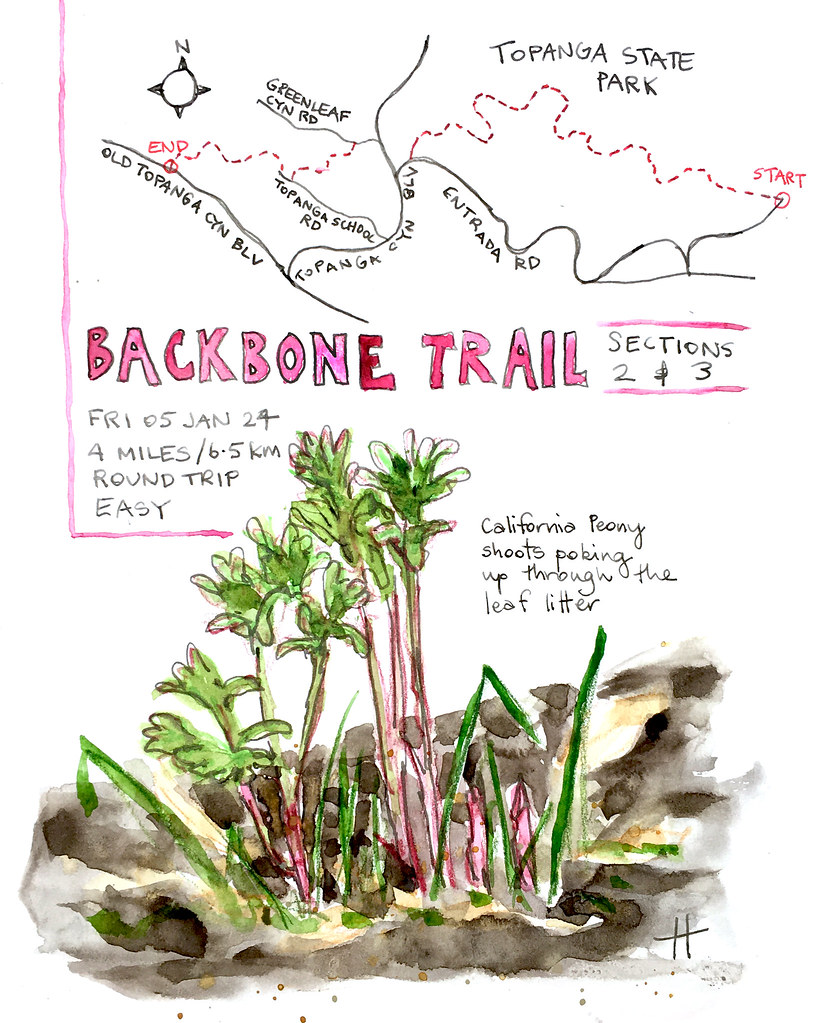
Paeonia californica

Easy part of the Backbone Trail. Glad to see the native peonies emerging!

Paeonia californica, a perennial herbaceous plant reaching a height of 35–70 cm, undergoes subterranean retreat during the summer and reemerges with the onset of winter rains. Its flowering period primarily spans from January to March, followed by the development of two to five fruits per flower.

Indigenous to southwestern California and northern Baja California, California peonies thrive in dry hillsides within the coastal sage scrub and chaparral communities. Frequently found as understory plants, they grow up to an elevation of 1500 m.

Catocala cara

Underwing moths (Catocala spp.) are known for having dull, camouflaging forewings, and brightly colored hindwings which they suddenly flash open if disturbed. It is believed that the patterning of the hindwings resembles the eyes of a predatory animal, such as a cat. A bird or other small predator that is not used to this display is likely to be frightened, allowing the moth to escape.

Of the more than 250 known species, slightly less than half are found in North America—mostly in the United States—while the rest occur in Eurasia.

backbone #1

Over the next few months, I’ll be hiking the 67-mile/108-km Backbone Trail in easy chunks. Annette and I started with section one on New Years Day, Will Rogers to Trippet Ranch. It was a gorgeous day, and we were tired and happy at the end. A great way to start the year!