I was attracted to the colourful vessels on the shelves, and found myself a seat facing them, at the end of a long table. It’s only now that I’ve scanned and cropped the image that I see how skewiff (one of my Mum’s favourite words) those shelves are! It’s quite comical, really. That upper shelf is ready to take off into orbit!
The fernery is a never ending source of visual delight and sketching inspiration. The very first time I came to the house (nearly ten years ago) I had a vision for what this space could be 🌿🪴
Astrida and I went to the Fowler Museum to see a wonderful exhibit of Indigenous Australian textiles from the Northern Territory. Inspired by the graphic images, I played in my sketchbook when I got home.
If you’re in Los Angeles, it’s worth a visit. The exhibition runs through July 10, 2022.
In Liz Steel’s Sketchbook Design class, she shows how, even if you don’t particularly like your first sketch, you can rescue the spread by adding another one, and/or other design elements. I’m not going to win any awards with this spread, but it’s somewhat improved from where it was an hour earlier.
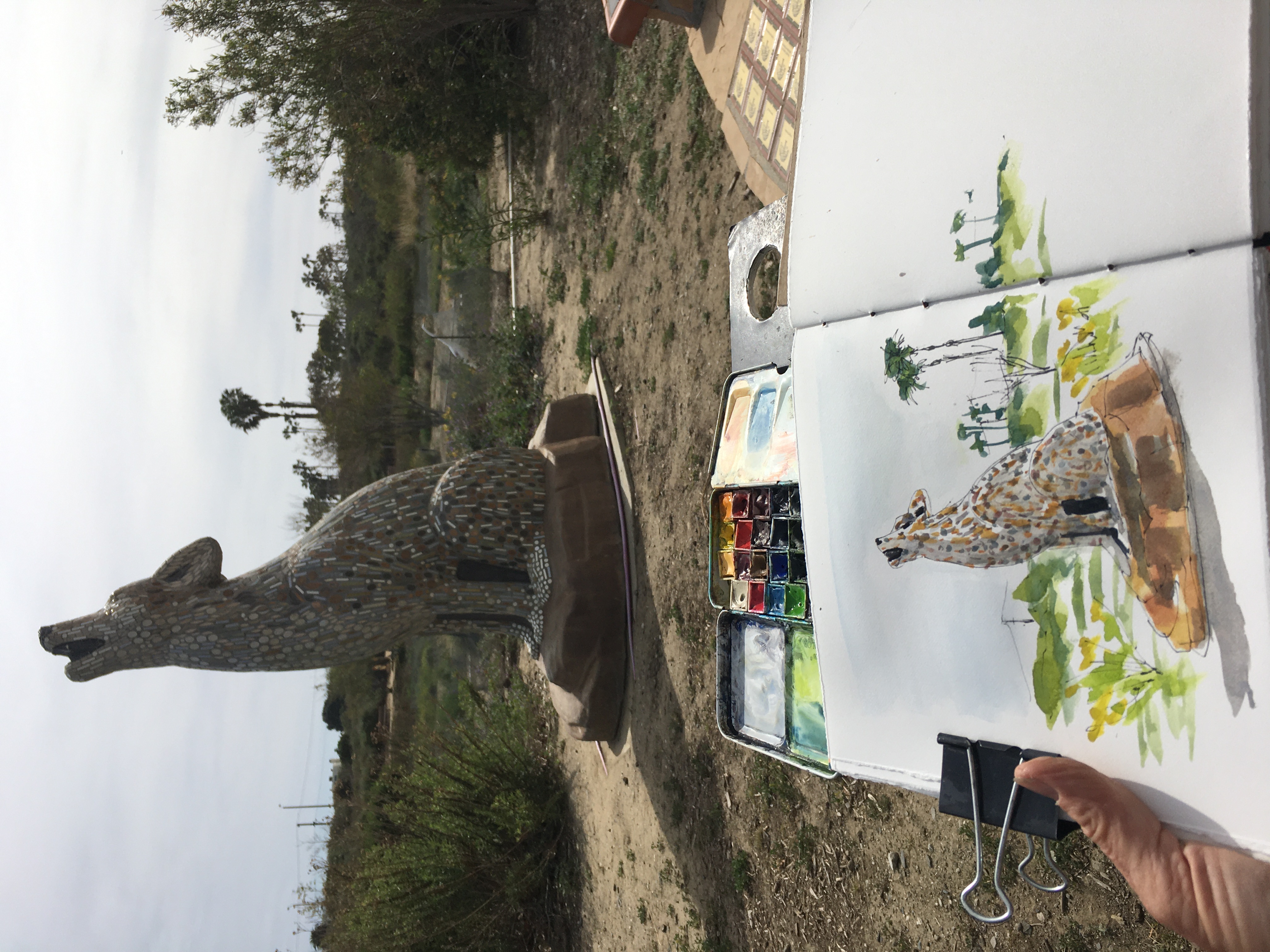
I sketched this coyote a few weeks ago from a different angle. There are eight mosaic sculptures in Malibu’s Legacy Park by the artist Robin Indar. Maybe I’ll eventually get around to sketching them all.
The bush sunflowers are busting out all over our sea-cliffs, making “very effective masses of color, in fine contrast to the blue of the sea below and the sky above”, as Margaret Armstrong rightly observed over a hundred years ago. The bees are happy, and later when the seeds have set, the birds will be too.
In 1910, Johnny Mott, a famous LA attorney, built an adobe home on the banks of Malibu Creek, in what was then Crag’s Country Club. It was reported in the Los Angeles Times that Mott’s longtime friend, President Herbert Hoover, was a frequent guest.
When 20th Century Fox bought the property in 1946, the adobe was retained as a movie set. You can see it in “Viva Zapata!” (1952), starring Marlon Brando, but by 1970 it had fallen into ruins.
The Mott Adobe ruins are now part of Malibu Creek State Park, and only the dramatic stone fireplace is left standing.
We have a lending library for docents at MCSP, and yesterday I discovered this treasure: Field Book of Western Wild Flowers by Margaret Armstrong, published in 1915. It’s a small, thick book, filled with 500 black and white illustrations and 48 watercolour plates, and the most delightful plant descriptions. Example (Easter Bells, p 28):
“A patch of these flowers bordering the edge of a glacier, as if planted in a garden-bed, is a sight never to be forgotten. Pushing their bright leaves right through the snow they gayly swing their golden censers in the face of winter and seem the very incarnation of spring.”
Makes me want to gayly swing my golden censer 😁
You can see the text here on Gutenberg, but of course holding the hundred year old book in one’s hands is an infinitely more special experience. I’ve borrowed it, and I’m already feeling sad about the day I need to return it to the shelves.
So many wildflowers on today’s hike! I counted 32 different species, including several that were new to me. This one’s figwort or bee plant. The flowers are small, but look like cute little faces.
(Oops, just saw a typo on my sketch. It’s Scrophularia. Sounds like a disease, doesn’t it?)




 hashiworks